
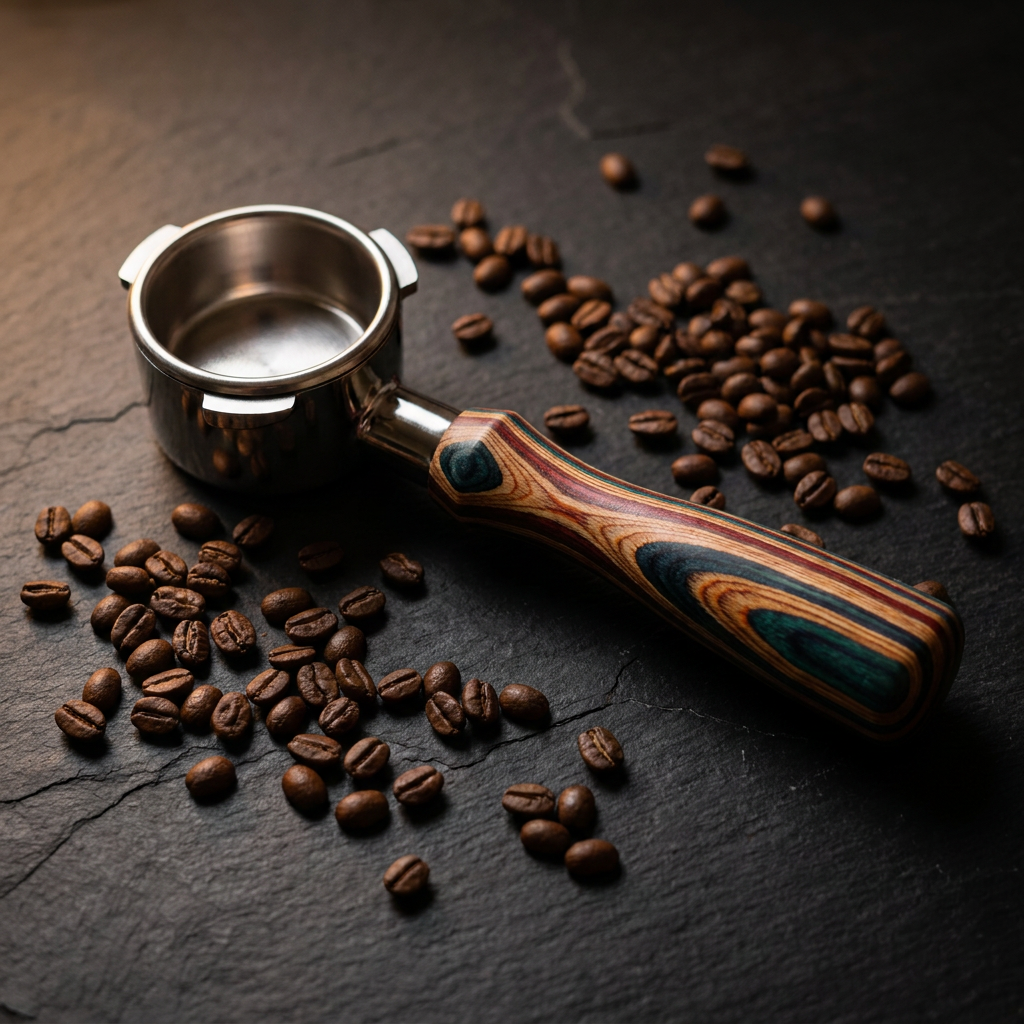
A bottomless portafilter, also sold as a “naked” portafilter, has no spout: the shot pours straight out of the basket where you can see it. That is the whole product. The question to ask before buying one is not whether it makes better espresso (on its own, it does not) but whether you will use what it shows you. The answer depends more on your grinder and your habits than on the portafilter.
What a bottomless portafilter actually changes
Every portafilter holds a basket full of ground coffee. A regular, spouted portafilter routes the extracted shot through one or two small spouts before it reaches your cup. A bottomless portafilter removes the spouts entirely, so the shot exits directly from the bottom of the basket — you're looking at the raw extraction, not a filtered or merged version of it. If water is moving through the puck evenly, you'll see a smooth, steady, cone-shaped stream. If it isn't, you'll see that too, immediately: thin fast jets, a spray off to one side, or a stream that turns pale and watery way too early. A spouted portafilter has the exact same extraction happening underneath — it just doesn't show it to you.
Bottomless vs. regular vs. pressurized
These three get lumped together a lot, so here is the breakdown. “Bottomless” and “naked” are the same product — some sellers use one term, some use the other, and a few use both on the same listing, so don't go looking for a difference that isn't there. The real comparison worth understanding is bottomless against a regular spouted (non-pressurized) portafilter, and against a pressurized basket — the kind that ships stock in a lot of home machines and is built to force a consistent-looking shot out of an inconsistent grind and dose.
| Feature | Bottomless / Naked | Regular (Spouted) | Pressurized |
|---|---|---|---|
| What you see | The full, raw shot stream straight from the basket | The shot after it's routed through one or two spouts | The shot after it's forced through a narrow restrictor plate |
| Shows channeling | Yes, instantly and clearly | No — the spouts hide it | No, and the restrictor would mask it even if you could see it |
| Forgives an inconsistent grind or tamp | No | No | Yes — that's the entire point of the restrictor |
| Ceiling on shot quality | As high as your technique gets it | As high as your technique gets it | Capped by the restrictor, regardless of technique |
| Best fit for | Dialing in and learning what channeling looks like | Same skill level, minus the visual feedback | Pre-ground coffee and minimal fuss |
The real case for one
The case for a bottomless portafilter is information. When you can see the shot, you know right away whether your grind, dose, distribution, and tamp worked together, instead of guessing from taste twenty seconds later. That feedback is why people who switch tend to get better at pulling shots. The portafilter does no work itself; it shows you yours.
- Immediate, visual proof of channeling — you don't have to guess why a shot tastes sour or thin
- Forces real technique: distribution, tamp level, and dose all show up in the stream
- Nothing between the basket and the cup, so less turbulence and less crema knocked off on the way down
- Works with any basket you already own — it's the holder that changes, not the basket
Where it falls short
It's not the right upgrade for everyone, and a straight answer means saying where it doesn't help. If your machine came with a pressurized basket and you have no plan to swap it for a non-pressurized one, a bottomless holder won't show you anything useful — the restrictor does the same job either way, spouted or not, so pairing the two just adds mess with no extra information. Bad shots on a bottomless spray outward instead of down, so expect some cleanup while you're still dialing things in. And if you're happy topping off drip coffee occasionally and don't care about tuning individual shots, this solves a problem you don't have.
- No benefit if you're still running the stock pressurized basket
- More splatter and cleanup risk while you're still learning
- Won't fix a bad or inconsistent grinder — it just shows you the grinder is the problem
- Not worth it if you don't care about adjusting shots based on what you see
Channeling: the thing nobody warns you about
Channeling is water finding the path of least resistance through the coffee puck instead of moving through it evenly, and a bottomless portafilter is the fastest way to actually see it happen. The tell is a shot that starts fine, then thins out and turns pale (blonde) way too early, or squirts off to one side instead of pouring straight down. A shot that finishes in fifteen seconds when you were aiming for twenty-five almost always means channeling, not a fast grind.
- Uneven distribution before the tamp — clumps and gaps in the grounds create high- and low-resistance zones. Breaking up clumps with a distribution tool before tamping works far better than tapping the portafilter on the counter.
- A tilted or uneven tamp — even a couple degrees off level sends the tamp deeper on one side, and water follows the shallow side.
- Wrong dose for the basket — underfilling leaves a gap at the top the water rushes through; overfilling can crack the puck against the shower screen.
- An inconsistent grind — a mix of fine and coarse particles from a worn or cheap grinder extracts unevenly no matter how careful the tamp is.
- An uneven spray from the shower screen itself — water hits the top of the puck unevenly before it ever touches the coffee.
A puck screen helps with that last one — it's a thin stainless disc that sits on top of the grounds and breaks up the incoming spray before it reaches the puck, which is worth doing whether or not you go bottomless. A level tamp is also easier to get consistently with a flat-based espresso tamper sized to your basket, rather than eyeballing it.
Picking a bottomless portafilter that actually fits your machine
Fitment matters more than the material you pick. A bottomless portafilter has to match your machine's group head size exactly — there's no universal fit, and forcing the wrong size risks damaging the group gasket. Most home espresso machines fall into one of two sizes.
If you're running a 54mm home machine — Breville, Sage, or Delonghi's Barista line — four of these fit: the Recycled Skateboard Wood 54mm Bottomless Portafilter, the Rosewood 54mm Bottomless Portafilter, the Resin & Wood 54mm Bottomless Portafilter, and the 54mm listing of the Layered Birch Bottomless Portafilter. All four use the same handle attachment as your stock portafilter, so you're swapping the whole unit and keeping your existing baskets.
If you're on a 58mm E61 group-head machine — Rancilio, Rocket, ECM, Profitec, Lelit, and similar — two options fit: the Recycled Skateboard Wood 58mm Bottomless Portafilter, and the 58mm listing of the Layered Birch Bottomless Portafilter. Check your machine's manual if you're not sure which size you have — 54mm and 58mm baskets look similar but are not interchangeable.
The bottom line
A bottomless portafilter is worth it if you already care what is happening inside the puck: you have a decent grinder, you use or are about to switch to a non-pressurized basket, and you want to improve your shots. It is not worth it if you are happy with your current results, plan to stay on a pressurized basket, or do not want the extra mess while you learn. It will not make your coffee better by itself. It shows you whether your technique already does.
More guides
Puck Screen Sizes Explained: 54mm, 58mm, and La San Marco
Puck screens are not one-size-fits-all. Here is how to pick the right diameter for your machine, including the tricky La San Marco 54.5mm case, before you buy.